Showing posts with label History. Show all posts

Saturday, 1 June 2013

Château de Versailles, France

The Palace of Versailles is located around 20 kilometres away from Paris to the south-west, and is easily reachable by train from Paris.  Upon arriving at the train station you will immediately be accosted by various ticket sellers and tour guides offering "hassle free" ticketing for the Palace.

Honestly, I am not so sure it really requires that... we simply walked to the Palace and purchased tickets ourselves, there was no huge wait, and the process was quite painless.  

Keep in mind there are actually several different ticket options to choose from.

Trianon Palaces and Marie-Antoinette Estate: €10
Grand Trianon and gardens of the Grand Trianon, Petit Trianon, Queen's hamlet, French and Anglo-Chinese gardens, French pavilion, temple of Love...

The Palace: €15
The Palace's most famous places: the Hall of Mirrors, Grand Apartments of the King and of the Queen, King's Bedchamber...Exhibitions are included in the price of the ticket.
You also receive an audio tour guide which is available in multiple languages.

The Passport: 18
To discover the Versailles Estate in all its glory, the Passport gives you admission to all the Palace tours : grounds, Trianon palaces and Marie-Antoinette's Estate.  Exhibitions are included in the price of the ticket.
+ Musical Fountain Show, Musical Gardens (from April to October) 25.

Hidden Versailles: 16
Guided by a lecturer, you will discover the private apartments of Louis XV and Louis XVI, the Royal Opera or the Royal Chapel. These places are open only to accompanied groups.


Almost everything about Versailles screamed at me justification for the French Revolution, in my travels around Europe I have seen all manner of excess and gaudy gold encrusted fences.  But everything about this palace just screams obnoxiousness.  I honestly don't know how they ever lived with themselves.


Look at that thing.... seriously guys... its a gate!  Anyway, enough of my revulsion and on with the history lesson...
Originally Louis XIII had built a hunting lodge on the site in 1624 after being introduced to the area by its owner Albert de Gondi, in 1632 he purchased the land outright from the Gondi family and began expanding the lodge into a complete château.  This would later form the basis of the palace as it stands today.
When his son Louis XIV became king he set about transforming and expanding on the original château making it one of the biggest palaces in the world.
And in 1682 he moved the French court to the palace establishing it as the center of leadership.


 ‘A Toutes Les Gloires de la France’ – ‘To all the glories of France’
This was inscribed on the buildings during Louis XIV's reign between the years 1682 and 1715, and the palace really was testament to the French empire at that time.


Many years, and many wars, and many kings of France went on... the palace continued to be developed all the way through to 1788 and King Louis XVI... and this is where things started to get really interesting.
From 1776 Louis XVI had been supporting the American efforts to achieve their independence from Great Britain, this of course had come at quite a heavy cost, mostly to the citizenry.  This during a time period where the famous "Encyclopédie" had been released only a few years earlier promoting the idea of Enlightenment which caused enormous upset among the French nobility.


"If exclusive privileges were not granted, and if the financial system would not tend to concentrate wealth, there would be few great fortunes and no quick wealth. When the means of growing rich is divided between a greater number of citizens, wealth will also be more evenly distributed; extreme poverty and extreme wealth would be also rare." (Wealth, Diderot) - An excerpt from Encyclopédie which neatly summarized the situation in France at the time.


The people were paying excessive taxes to help save the country from the enormous debts it had incurred during the Seven Year War and the American Revolutionary War while the aristocracy paying significantly less tax were painting their ceilings gold.


So as we walked through the palace and looked at the numerous statues of French nobility taking on such mythic poses as above... I was really quite angry.  I had never really given much thought to the French Revolution, I never studied it in school and it was just a passing note in history to me.


But suddenly it all made sense... and I had to fight the urge to throw a few flaming torches onto the ridiculous furnishings myself.


Even their table lamps had to be chandeliers... these people were asking for it.


The Hall of Mirrors... quite possibly the most obnoxious room in the entire palace....the principal feature of the hall are the seventeen mirror-clad arches that reflect the seventeen arcaded windows that overlook the gardens. Each arch contains twenty-one mirrors with a total complement of 357 used in the decoration of the Hall of Mirrors.


This travel blog seems to have taken a very negative turn for the worst... and I really am trying to write something nice, to encourage you to visit this place.  But every time I think back on it I just want to slap a rich French person.


Look how smug she is right now... she won't be smirking like that when she is chased off by an angry mob.


The Queen's bedchamber, another fine example of excessive extravagance. There is a barely discernible 'hidden door' in the corner near the jewel cabinet through which Marie Antoinette escaped the night of 5/6 October 1789 when the Paris mob stormed Versailles.


Oh such bravery and valor depicted on the walls... here young master Napoleon Bonaparte fought somewhere around 15,000 Ottomans at Abu Qir, Egypt.  Though the painting makes it look like he managed this alone I think he may have had a few friends help out.
However he certainly makes a mockery of Louis XVI, who couldn't even manage 7,000 angry French women who arrived in Versailles with various canons and assorted weapons.


This is my friend Chrissy being a photographer... look how dashing she is! Like a secret agent!


Sadly when we visited the gardens were closed... so we really missed out on rather a lot of the grounds which would have been more interesting to me.  I shall go back sometime to visit them and post an update.
Who knows... by then I may stop hating everything this place represents.

NEXT UP! PRAGUE!

References:
Palace of Versailles - http://en.wikipedia.org/wiki/Palace_of_Versailles
Louis XVI - http://en.wikipedia.org/wiki/Louis_XVI
Marie Antoinette - http://en.wikipedia.org/wiki/Marie-Antoinette
Age of Englightenment - http://en.wikipedia.org/wiki/Age_of_Enlightenment
Encyclopédie - http://en.wikipedia.org/wiki/Encyclopedie
The French Revolution - http://en.wikipedia.org/wiki/French_Revolution


This work is licensed under a Creative Commons Attribution Non-commercial license.

Monday, 29 April 2013

Palais Garnier (The Paris Opera House), Paris, France

This will be the first of several blog posts which cover my time in Paris earlier this year, there were so many photos and locations that a single blog post would have felt really rushed.

So the first location, Palais Garnier is somewhere I had always wanted to visit, in an online game I played a lot of called LegendMUD the Paris Opera House was described in great detail and the real thing was everything I thought it would be.


Like a lot of things the facade is covered in gold, statues, and busts of various patrons of the opera house.


And yet somehow they it doesn't feel as obnoxious as it does in other places around France.


In fact it could be said that this single building inspired my new love of statue photography haha


The building was originally conceived by Emperor Napoleon III, an interesting fact is that it was due to an attempted assassination as he was leaving the Opera with Empress Eugene, he then declared a competition to design an entirely new Opera House.


In 1860 Charles Garnier won this contest, a site was selected and the land was cleared, however the site contained a huge amount of groundwater which could not be drained.
Garnier then devised a second foundation, in the form of a large concrete tank and watercourse, this would hold the moisture and the weight of the tank helps to stabilize the building.
This is also where the rumors began that the Opera House is built on top of a huge subterranean lake.


During a performance of Helle' in 1896 a tragedy occurred within the Opera house, two of the enormous counterweights which hold the chandelier in place dropped, smashing their way through the ceiling and killing Madame Chomette an audience member.  This tragedy as well as the strange rumors of an underground lake are the two most significant things which inspired Gaston Leroux to write The Phantom of the Opera.


I don't think I really have much more to add at this point, since we didn't take a formal tour so I missed out on all of the usual interesting tales about the building itself.


It is definitely an amazing building to walk through though, every corner and surface contains some beautiful artwork, or sculpture, and for the massive number it still doesn't feel obnoxious like the Palace of Versailles.


So much beauty in one place was probably the first time I really felt this way in Europe to be honest.


And so many chandeliers! You would think they would have been a little less excited about them after killing a patron.


Next Blog! - Sacre Coueur and famous graves!

References:
Wikipedia Entry for the Building - http://en.wikipedia.org/wiki/Palais_Garnier
Article about The Phantom - http://bit.ly/aZT7Y9
Article about the Chandelier Accident - http://bit.ly/189WiVG
Charlies Garnier - http://en.wikipedia.org/wiki/Charles_Garnier_(architect)
Gaston Leroux - http://en.wikipedia.org/wiki/Gaston_Leroux

This work is licensed under a Creative Commons Attribution Non-commercial license.

Thursday, 22 November 2012

Munich, Germany


Last weekend I visited Munich with some friends of mine, and I have to say that it is one of the most interesting places I have been so far in Germany.
Its native name, München, is derived from the Old High German Munichen, meaning "by the monks' place" and this is due to the fact that the town was originally situated near a monastery of the Benedictine monks.
The city has a rich history being the capital of Bavaria, and is well known for its beer!


However as we learned on a free city tour, there are a great many other amazing details about Munich your average tourist would not know.
For example the church built in the centre of the city (Frauenkirche) has an interesting history wherein the architect made a deal with the devil to have it completed within 20 years.
The church was built by Jörg “Ganghofer” Halspach in the then record time of 20 years (1468-1488) and the towers were added 30 years later.


The story goes that the devil agreed to finance the church, provided Halspach built it without windows running down the aisles. When the work was done Halspach led the Devil to a point near the entrance where none of the side windows could be seen – the view was blocked by 22 inner columns.
The Devil threw a tantrum and stamped his foot real hard, leaving a mark that remains to this day. There always seems to be a wind blowing around the church and that’s said to be Satan himself, circling around looking for the side windows.

Here is the devils footprint!


We also learned some fascinating things about the world famous beer hall Hofbrauhaus am Platzl.
Wilhelm V., Duke of Bavaria really loved beer, and he was not happy enough with the locally brewed beers, so he would import from the city of Einbeck in Lower Saxony.
Wilhelm then asked his royal court to come up with a way to reduce these outgoing costs and so on September 27 1589, his advisors recommended they build a brewery of their own.
So they hired the master brewer of the Geisenfeld Monastery, to assist with planning the new brewery and to devise a recipe for a "brown" beer.  The brewery started in the “Alter Hof” ( Old Court ) in 1592.
It was called the “brown” Hofbräuhaus as only brown ale was brewed there.
Wilhelm’s son and successor, Duke Maximilian I., preferred wheat beers and to secure the Hobräuhaus as the best in Munich he banned any other private brewery from producing wheat beers.
This caused so much demand for wheat beer that he moved the Hobräuhaus to Platzl, where it became known as the "white" Hobräuhaus due to its new specialty in wheat beers.


An interesting side note to this is that during the Thirty Year War, the Swedish army arrived in Munich, and rather than simply destroying it and moving on as they usually did, they decided to stay since they loved the city so much.
Duke Maximilian I. had fled with his own army before the Swedish army had arrived, and so the citizens of Munich had to tolerate these invaders living amongst them.
After some time they asked if there was some way to pay the Swedes to leave, it was decided that 300,000 gold pieces would suffice.
The citizens tried their hardest and raised 180,000 gold pieces, however that was still not enough, so they made a deal to pay the remainder with the beautiful wheat beer of which they had an abundance.
And so the Swedish army took the beer and left... the citizens decided to throw a party in Marienplatz square, when Maximilian arrived to participate they were naturally a little upset.
So he told them that he had gone to the alps to find a high place to pray to Mother Mary for protection from the Swedish Army and to deliver their city.
The citizens being quite gullible believed this, and it was decided a statue should be erected for Maximilian, however he declared that it should instead be a statue of Mary.
This is how the "Mariensäule" was built in 1638, and is also the reason "Schrannenmarkt" was renamed to "Marienplatz" in 1853.


But back to the Hofbräuhaus! In 1828 the now reigning King Ludwig I. made a proclamation that the Hofbräuhaus be opened to the general public (women were excluded) rather than simply court officials and other dignitaries.
And this is how the Hofbräuhaus has continued to this day (only now women are also allowed!)
In 1844 not to be outdone by his previous generosity King Ludwig I. declared that beer should be sold at a fixed price, so that the working class and military could also afford a drink.

Enough about beer!
What about a castle?

On a nice Saturday, we hired a car, and drove through some beautiful countryside to a town called Hohenschwangau where there are two amazing castles.


The first and most famous is Neuschwanstein, which looks like something from a Disney movie (and is actually the basis for the castle in Cinderella) this castle was built by King Ludwig II. of Bavaria and was a tribute to composer Richard Wagner as well as a private retreat for the King himself.


The second is Hohenschwangau, which was rebuilt from ruins by King Ludwig II's father King Maximilian.
Unfortunately we didn't have time for the tours, but here are some pictures, and I have included links to the respective articles below.


What about a local past time?

ICE HOCKEY! Everyone knows I am not a huge sports person, but since I had played field hockey when I was younger I figured I could make an exception to see an ice hockey game.
It was actually really fun, we drank, we cheered, and had an exceptional time.  The game was Munich vs Augsburg, the final score was 5-0 to Munich.


Since this post is already very long, I will stop...

NEXT TIME! Berlin for a Garbage concert and sightseeing, London for Christmas, and Scotland for New Years!


References:
http://en.wikipedia.org/wiki/Munich_Frauenkirche - Frauenkirche
http://en.wikipedia.org/wiki/Eishockeyclub_M%C3%BCnchen – Munich Ice Hockey Team
http://en.wikipedia.org/wiki/Hofbr%C3%A4uhaus_am_Platzl – Hofbrauhaus am Platzl
http://en.wikipedia.org/wiki/Neuschwanstein_Castle - Castle Neuschwanstein
http://en.wikipedia.org/wiki/Hohenschwangau_Castle - Castle Hohenschwangau
http://en.wikipedia.org/wiki/Hohenschwangau - The town the castles are in
http://www.newmunichtours.com/ - free city tour (our guide was Blake)
http://www.destination-munich.com/frauenkirche.html - Destination Munich entry on Frauenkirche
http://www.hofbraeuhaus.de/en/01/hist_anfang_en.html - History of the Hofbrauhaus
http://www.neuschwanstein.de/englisch/palace/index.htm - Castle Neuschwanstein

Tuesday, 17 July 2012

Marienburg Castle, Hannover, Germany

Over the weekend Ben and I took a drive to Marienburg Castle (Schloss Marienburg), being that this was my first visit to a real castle I was pretty excited actually.
Naturally as is customary on any weekend excursion we first stopped and had some lunch and a beer at the restaurant in the courtyard (reasonably priced and excellent food)
After lunch we took a stroll to the top of one of the towers to take some photos, and then we took the proper guided tour of the castle itself.
Unfortunately you cannot just wander about, and no photography is allowed inside the castle so you will really just have to make do with some photos from outside this time.

I will however outline some of the interesting points from the tour.


The castle was originally given as a gift by King George V of Hannover to his wife Marie as a 39th birthday present in 1857, at the time he gave her the hill which the castle was later to be built on, as well as the plans for the castle itself.  Because he was blind he had the architects create a model of the castle in cork so that he could "see" it himself, both George and his wife Marie were lovers of the arts and music, and it was envisioned that the castle would eventually become a cultural centre for these things.


In 1866 the war with the Prussians forced King George to flee and live in exile, however because Marie owned the land outright the Prussians could not claim it directly, and so she lived there for quite awhile anyway (which I found really cool, she was obviously a pretty hardcore lady), eventually she re-joined her husband in Austria.


Another interesting point are the ties to the English throne, since the House of Hannover actually had many kings who were kings of the United Kingdom, as well as of Hannover, and of course Queen Victoria was part of the family, feel free to read the links at the bottom for more information on that.


Another interesting fact was that the castle used a revolutionary form of underfloor heating which runs through most of the rooms, though it is not enough warmth to heat the larger rooms, it was really quite ahead of its time when the castle was built, and shows that the King and his architects were quite forward thinking.


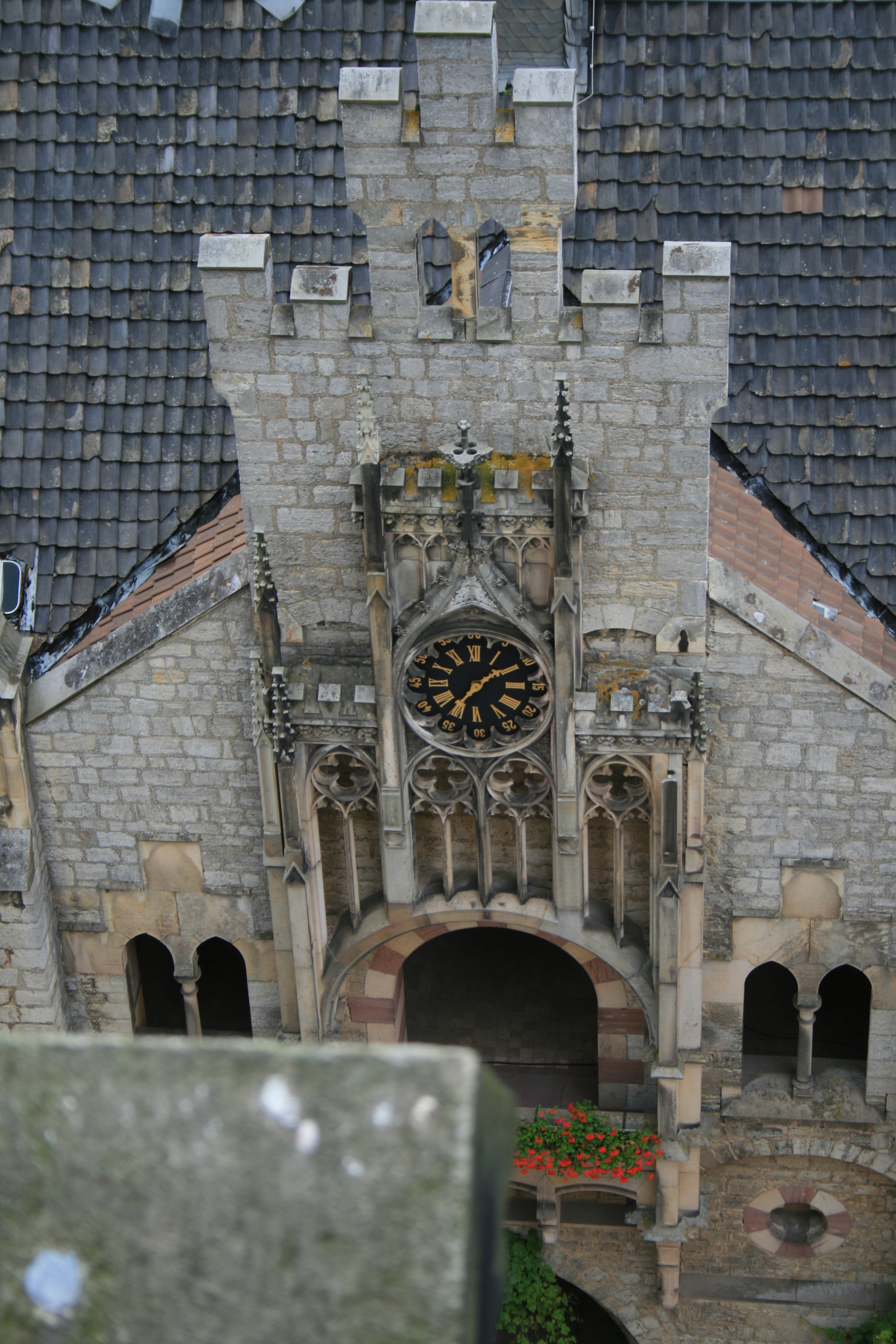
This is the view from on top of the tower, looking down on the clock in the courtyard.


Links:
http://en.wikipedia.org/wiki/George_V_of_Hanover
http://en.wikipedia.org/wiki/Marie_of_Saxe-Altenburg
http://en.wikipedia.org/wiki/House_of_Hanover
http://www.reiseland-niedersachsen.de/en/marienburg-castle-1

owch

Just realised all my photos for this blog were hosted via Google Drive on my old account, guess I'll have to re-upload em all sometime. ...