Part Two of the Paris blog! Several months after it happened of course...
A visit to the Sacré-Cœur (or Basilica of the Sacred Heart of Paris as it is also known), this impressive basilica resides at the top of the hill in Montmartre (the famously bohemian neighbourhood of Paris)
The basilica was originally conceived of in 1870 as a form of penance by Bishop Fournier, who suggested that the reason for Frances failure during the Franco-Prussian war was due to the moral decline of their society. It was for this reason that the basilica was erected in what was then Paris' most rebellious neighbourhood.
The basilica was constructed using Château-Landon stone, which is very high in Calcite, which gives the building its distinctive white exterior.
Within the basilica is also housed one of the worlds heaviest bells, the Savoyarde which weighs an impressive 19 tons... however we did not spend too much time inside... instead we visited the catacombs beneath the basilica.
Montmartre means the Mount of the Martyr, and within Sacre Coueur's catacombs you will find many, beginning with the most famous St. Denis... an interesting fact about martyrs... St. Denis is a cephalophore, which is a very specific type of martyr which carries its own severed head.
Clearly this happened enough that they needed to create an entire word for it... weird. There are in fact over 100 of them in French history alone. (and it is my new dream to locate more cephalophores around Europe!)
St. Denis is quite the badass however... it is said that when he was beheaded in Montmartre he walked all the way to the suburb which is now named after him, and the entire way he continued preaching from his severed head.
St. Francois Xavier, is the patron saint of "Catholic Missions" and was quite the globetrotter, performing missionary work in India, Japan, and Indonesia. It is said that aside from Paul the Apostle, he converted more people to the faith than anyone in history.
Shamefully I don't recall specific details about these next few gentlemen, but I believe they were the priests responsible for the building of the basilica. (shoot me a note if I am wrong)
The man above is Cardinal Leon Adolphe Amette who was archbishop of Paris between 1908–1920, he was also the man to consecrate the basilica in 1919.
Unfortunately this one I do not have any details about...
And above the main relic chapel in the centre of the crypt. Interestingly there is some mystery around the crypts... it is said that somewhere inside lies a piece of the sacred heart of Jesus, this is where the basilica gets its name.
This is mentioned in several guidebooks, and yet no official church documentation exists to back these claims.. so if a piece of the heart does reside somewhere in the crypts it is certainly not marked in any way.
This man I am sure was a kind, godly and generous man who has some fantastic significance. But I challenge you to not immediately think of the Emperor from Star Wars... this statue was very unnerving.
So there you go, a very brief summary of the roughly twenty minutes we spent at Sacre Couer!
Next up! Famous Graves and the Dali Museum!
References:
Sacre Coueur - http://en.wikipedia.org/wiki/Basilica_Of_The_Sacred_Heart
This work is licensed under a Creative Commons Attribution Non-commercial license.
Saturday, 1 June 2013
Monday, 29 April 2013
Palais Garnier (The Paris Opera House), Paris, France
This will be the first of several blog posts which cover my time in Paris earlier this year, there were so many photos and locations that a single blog post would have felt really rushed.
So the first location, Palais Garnier is somewhere I had always wanted to visit, in an online game I played a lot of called LegendMUD the Paris Opera House was described in great detail and the real thing was everything I thought it would be.
Like a lot of things the facade is covered in gold, statues, and busts of various patrons of the opera house.
And yet somehow they it doesn't feel as obnoxious as it does in other places around France.
In fact it could be said that this single building inspired my new love of statue photography haha
The building was originally conceived by Emperor Napoleon III, an interesting fact is that it was due to an attempted assassination as he was leaving the Opera with Empress Eugene, he then declared a competition to design an entirely new Opera House.
In 1860 Charles Garnier won this contest, a site was selected and the land was cleared, however the site contained a huge amount of groundwater which could not be drained.
Garnier then devised a second foundation, in the form of a large concrete tank and watercourse, this would hold the moisture and the weight of the tank helps to stabilize the building.
This is also where the rumors began that the Opera House is built on top of a huge subterranean lake.
During a performance of Helle' in 1896 a tragedy occurred within the Opera house, two of the enormous counterweights which hold the chandelier in place dropped, smashing their way through the ceiling and killing Madame Chomette an audience member. This tragedy as well as the strange rumors of an underground lake are the two most significant things which inspired Gaston Leroux to write The Phantom of the Opera.
I don't think I really have much more to add at this point, since we didn't take a formal tour so I missed out on all of the usual interesting tales about the building itself.
It is definitely an amazing building to walk through though, every corner and surface contains some beautiful artwork, or sculpture, and for the massive number it still doesn't feel obnoxious like the Palace of Versailles.
So much beauty in one place was probably the first time I really felt this way in Europe to be honest.
And so many chandeliers! You would think they would have been a little less excited about them after killing a patron.
Next Blog! - Sacre Coueur and famous graves!
References:
Wikipedia Entry for the Building - http://en.wikipedia.org/wiki/Palais_Garnier
Article about The Phantom - http://bit.ly/aZT7Y9
Article about the Chandelier Accident - http://bit.ly/189WiVG
Charlies Garnier - http://en.wikipedia.org/wiki/Charles_Garnier_(architect)
Gaston Leroux - http://en.wikipedia.org/wiki/Gaston_Leroux
This work is licensed under a Creative Commons Attribution Non-commercial license.
So the first location, Palais Garnier is somewhere I had always wanted to visit, in an online game I played a lot of called LegendMUD the Paris Opera House was described in great detail and the real thing was everything I thought it would be.
Like a lot of things the facade is covered in gold, statues, and busts of various patrons of the opera house.
And yet somehow they it doesn't feel as obnoxious as it does in other places around France.
In fact it could be said that this single building inspired my new love of statue photography haha
The building was originally conceived by Emperor Napoleon III, an interesting fact is that it was due to an attempted assassination as he was leaving the Opera with Empress Eugene, he then declared a competition to design an entirely new Opera House.
In 1860 Charles Garnier won this contest, a site was selected and the land was cleared, however the site contained a huge amount of groundwater which could not be drained.
Garnier then devised a second foundation, in the form of a large concrete tank and watercourse, this would hold the moisture and the weight of the tank helps to stabilize the building.
This is also where the rumors began that the Opera House is built on top of a huge subterranean lake.
During a performance of Helle' in 1896 a tragedy occurred within the Opera house, two of the enormous counterweights which hold the chandelier in place dropped, smashing their way through the ceiling and killing Madame Chomette an audience member. This tragedy as well as the strange rumors of an underground lake are the two most significant things which inspired Gaston Leroux to write The Phantom of the Opera.
It is definitely an amazing building to walk through though, every corner and surface contains some beautiful artwork, or sculpture, and for the massive number it still doesn't feel obnoxious like the Palace of Versailles.
So much beauty in one place was probably the first time I really felt this way in Europe to be honest.
And so many chandeliers! You would think they would have been a little less excited about them after killing a patron.
Next Blog! - Sacre Coueur and famous graves!
References:
Wikipedia Entry for the Building - http://en.wikipedia.org/wiki/Palais_Garnier
Article about The Phantom - http://bit.ly/aZT7Y9
Article about the Chandelier Accident - http://bit.ly/189WiVG
Charlies Garnier - http://en.wikipedia.org/wiki/Charles_Garnier_(architect)
Gaston Leroux - http://en.wikipedia.org/wiki/Gaston_Leroux
This work is licensed under a Creative Commons Attribution Non-commercial license.
Friday, 29 March 2013
Toyohashi, Japan
Welcome to my latest EXTREME TOURISM entry, this is one day in Toyohashi, Japan!
Toyohashi is an interesting city really, I was only there for a few days and didn't really have a local guide or much to go on, aside from the fact that there was a castle to be seen!
So I set off towards Toyohashi City Park where the castle could be found.
Along the way to the castle there was a series of really quite disturbing statues, each had a plaque which contained a story, if only I knew how to read kanji...
These most excellent statues of a phoenix are outside the Toyohashi City Public Hall, there are additional phoenixes! (note: in mythology there was only ever one phoenix, so plural phoenixes is just an estimation)
Eventually we found the castle! This is actually a modern reconstruction of only one tiny part of what the castle had originally looked like. Here is some history from Wikipedia -
A castle was built on the banks of the Toyokawa River in 1505 by Makino Kohaku, a retainer of Imagawa Ujichika to secure his foothold on eastern Mikawa Province against the growing power of the Matsudaira clan in western Mikawa Province.
Due to its strategic location on a river crossing, the castle was involved in numerous battles during the Sengoku period, changing hands several times and was destroyed and rebuilt on several occasions.
From 1565, the castle came under the control of Tokugawa Ieyasu, who named Sakai Tadatsugu as castellan.
Following the Battle of Odawara in 1590, Toyotomi Hideyoshi ordered the Tokugawa clan to relocate to the Kanto region and assigned the castle to Ikeda Terumasa.
Ikeda developed the surrounding castle town and embarked on a massive and ambitious plan to rebuild Yoshida Castle.
However, following the Battle of Sekigahara, he was relocated to Himeji Castle, with the central keep not completed.
After the establishment of the Tokugawa shogunate, Yoshida Castle became the center of Yoshida Domain, a feudal domain, which occupied a strategic position on the Tokaido between Edo and Nagoya.
The domain was assigned to several different fudai daimyo clans until coming into the possession of the Matsudaira (Nagasawa-Okochi) clan in 1752, which remained in residence at Yoshida until the Meiji Restoration.
The final daimyo of Yoshida, Matsudaira Nobuhisa, surrendered the castle without resistance to the Meiji government in 1868.
The castle was turned over to the fledgling Imperial Japanese Army in 1871, but largely was destroyed in a fire in 1873.
Much of the castle grounds remained in the hands of the military until the end of World War II.
Following the end of the war, a portion of the Third Bailey was transformed into Toyohashi Park, and the modern Toyohashi City Hall was constructed on another portion.
In 1954, a three-story yagura, the Kurogane Yagura was reconstructed out of reinforced concrete. An art museum and sports facilities were later erected on the site of the Inner Baileys.
The previously mentioned art museum we did not venture inside, but outside was a fairly brazen statue of some naked ladies... saucy! The photo I have of the front was way too hot for this humble blog.
Here is a random man hole cover.... most excellent!
And the obligatory temple, which we also did not go inside... I may actually post some of my older photos of Japan sometime soon since I actually visited some really quite cool places in Tokyo last time.
Next time: Paris, France (FINALLY!)
References:
Toyohashi Wikipedia Entry - http://en.wikipedia.org/wiki/Toyohashi,_Aichi
Yoshida Castle - http://en.wikipedia.org/wiki/Yoshida_Castle
Siege of Yoshida Castle - http://en.wikipedia.org/wiki/Siege_of_Yoshida_Castle
Toyohashi City Museum - http://en.wikipedia.org/wiki/Toyohashi_City_Museum_Art_and_History
This work is licensed under a Creative Commons Attribution Non-commercial license.
Toyohashi is an interesting city really, I was only there for a few days and didn't really have a local guide or much to go on, aside from the fact that there was a castle to be seen!
So I set off towards Toyohashi City Park where the castle could be found.
Along the way to the castle there was a series of really quite disturbing statues, each had a plaque which contained a story, if only I knew how to read kanji...
These most excellent statues of a phoenix are outside the Toyohashi City Public Hall, there are additional phoenixes! (note: in mythology there was only ever one phoenix, so plural phoenixes is just an estimation)
Upon arriving at the park, we read the noticeboard to find out where the castle was and were directed along a path....
Eventually we found the castle! This is actually a modern reconstruction of only one tiny part of what the castle had originally looked like. Here is some history from Wikipedia -
A castle was built on the banks of the Toyokawa River in 1505 by Makino Kohaku, a retainer of Imagawa Ujichika to secure his foothold on eastern Mikawa Province against the growing power of the Matsudaira clan in western Mikawa Province.
Due to its strategic location on a river crossing, the castle was involved in numerous battles during the Sengoku period, changing hands several times and was destroyed and rebuilt on several occasions.
From 1565, the castle came under the control of Tokugawa Ieyasu, who named Sakai Tadatsugu as castellan.
Following the Battle of Odawara in 1590, Toyotomi Hideyoshi ordered the Tokugawa clan to relocate to the Kanto region and assigned the castle to Ikeda Terumasa.
Ikeda developed the surrounding castle town and embarked on a massive and ambitious plan to rebuild Yoshida Castle.
However, following the Battle of Sekigahara, he was relocated to Himeji Castle, with the central keep not completed.
After the establishment of the Tokugawa shogunate, Yoshida Castle became the center of Yoshida Domain, a feudal domain, which occupied a strategic position on the Tokaido between Edo and Nagoya.
The domain was assigned to several different fudai daimyo clans until coming into the possession of the Matsudaira (Nagasawa-Okochi) clan in 1752, which remained in residence at Yoshida until the Meiji Restoration.
The final daimyo of Yoshida, Matsudaira Nobuhisa, surrendered the castle without resistance to the Meiji government in 1868.
The castle was turned over to the fledgling Imperial Japanese Army in 1871, but largely was destroyed in a fire in 1873.
Much of the castle grounds remained in the hands of the military until the end of World War II.
Following the end of the war, a portion of the Third Bailey was transformed into Toyohashi Park, and the modern Toyohashi City Hall was constructed on another portion.
In 1954, a three-story yagura, the Kurogane Yagura was reconstructed out of reinforced concrete. An art museum and sports facilities were later erected on the site of the Inner Baileys.
The previously mentioned art museum we did not venture inside, but outside was a fairly brazen statue of some naked ladies... saucy! The photo I have of the front was way too hot for this humble blog.
Here is a random man hole cover.... most excellent!
And the obligatory temple, which we also did not go inside... I may actually post some of my older photos of Japan sometime soon since I actually visited some really quite cool places in Tokyo last time.
Next time: Paris, France (FINALLY!)
References:
Toyohashi Wikipedia Entry - http://en.wikipedia.org/wiki/Toyohashi,_Aichi
Yoshida Castle - http://en.wikipedia.org/wiki/Yoshida_Castle
Siege of Yoshida Castle - http://en.wikipedia.org/wiki/Siege_of_Yoshida_Castle
Toyohashi City Museum - http://en.wikipedia.org/wiki/Toyohashi_City_Museum_Art_and_History
This work is licensed under a Creative Commons Attribution Non-commercial license.
Stonehenge and Bournemouth, England
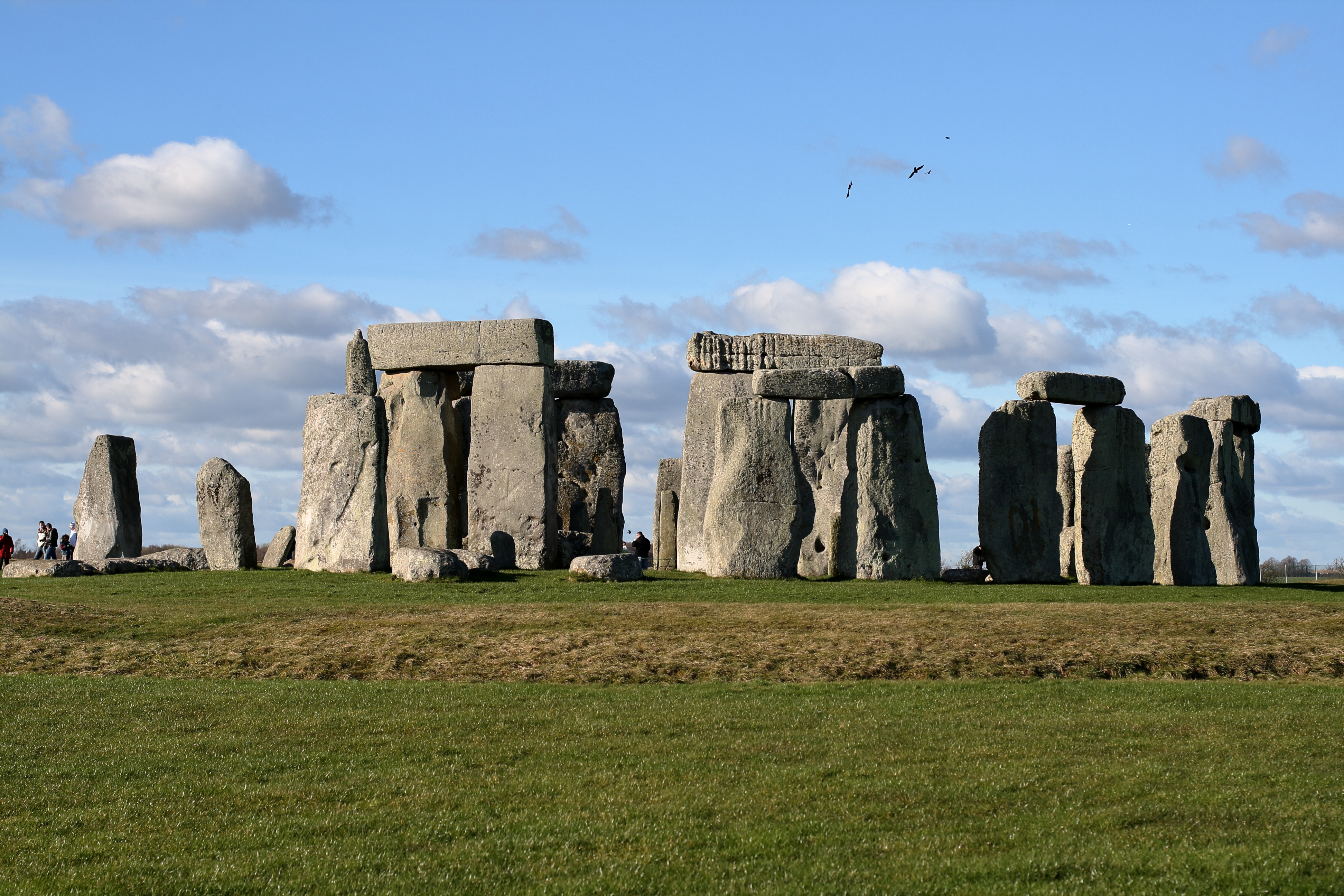
During one of the weekends that I had free on my visit to the UK, I decided that since I had a rental car and it was one of the few times it would make a lot of sense, and so with myself and a friend, we targeted Stonehenge as the travel destination.
Hours: Spring (1 Apr to 31 May) 09.30 - 18.00, Summer (1 Jun to 31 Aug) 09.00 - 19.00,
Autumn (1 Sept to 15 Oct) 09.30 - 18.00, Winter (16 Oct to 15 Mar) 09.30 - 16.00 (16Mar to 31Mar) 09.30 to 18.00
Boxing Day and New Year's Day 10.00 - 16.00
Admission: Adult - £7.80, Child (5 - 15) - £4.70, Child (Under 5) - Free, Concession (student, over 60) - £7, Family Ticket (2 adults + up to 3 children) - £20.30, English Heritage and National Trust Members - Free
Without a car it can be a little challenging to get there, you would need to catch one of the various tour buses from a nearby village or from London directly. These tend to be crowded and you lack the convenience of being able to take your time along the way and to arrive when you please. Some information about alternative transportation methods can be found in my references section at the bottom of this entry.
Located in Wiltshire, England and surrounded by beautiful farmland Stonehenge is still a place where you can almost feel history. There are a considerable number of theories about how Stonehenge was built, for what purpose and I honestly don't want to get into too much scholarly debate about that in a blog which is mostly about the beauty of travel. So let me just say this, of all of the destinations I have visited so far, this one really felt important for some reason I couldn't define. It is after all just a collection of rocks in a field.
Ok they are really quite huge rocks...
I get the feeling you are not going to let me away with so little information, so fine... one of the more interesting stories is that Arthurian legend (you know Arthur and Merlin, swords in rocks, etc) version of how Stonehenge was formed, basically the English heard about these amazing healing rocks which had been placed in Ireland by some giants, and they were quite famous for their healing powers.
Being a right English bastard the king at the time Aurelius Ambrosius wanted to create a monument to a bunch of soldiers who had died for him, so naturally the English go to Ireland and kill an awful lot of Irishmen only to discover that these giant rocks are actually a bit of a pain to move!
I laugh at the foolish Englishmen attempting to move such enormous things, so of course Merlin being the slippery wizard that he is devises a method to transport the rocks, and then convinces the giants to help him put it all together where it stands today.
This rock also comes with a fairly entertaining story, this is the Friar's Stone, or Heel Stone.
Basically if you are standing in the middle of Stonehenge and look at this stone, AND it is summer solstice, the sun rises over this stone.... but that is not the interesting part... how did it get there?
Well rumour has it that originally the Devil bought all the stones from an old Irish woman, while he was transporting them all to England and one of the stones dropped into the Avon river.
An elderly friar laughed and said "Nobody will ever know how these stones got here!"
The Devil being in no way a man for shenanigans yelled "That's what you think!" and hurled one of the stones at the Friar which caught him in the heel and has remained there ever since.
The pier is also a ferry terminal I believe, so you could theoretically travel from here to Brighton or other such places, but we had arrived quite late and only really had time for a quite brief stroll along the beach after dinner, and a quick few photos of the sun set.
The beach at Bournemouth I suspect during summer would be really quite nice, and was significantly less pebbley than I had been led to believe all English beaches were. Worth noting as well for anyone familiar with really old English comedy, Bournemouth is part of Dorset! If you haven't ever seen the film "Five Go Mad in Dorset" by Comic Strip, you owe it to yourself to find it!
Next time: Toyohashi, Japan! And then Paris, France!
References:
The Stonehenge Wikipedia Entry - http://en.wikipedia.org/wiki/Stonehenge
Stonehenge Visitors Information Site - http://www.stonehenge.co.uk
Bournemouth Wikipedia Entry - http://en.wikipedia.org/wiki/Bournemouth
Five Go Mad In Dorset - http://en.wikipedia.org/wiki/Five_go_mad_in_dorset
This work is licensed under a Creative Commons Attribution Non-commercial license.
Thursday, 14 March 2013
Cambridge, England
I will be very honest, I was only in Cambridge for an hour after a work meeting so I really didn't get time for proper tourism or to absorb the local history.
As such I am simply throwing some photos in at random, with no real explanations, these are all just beautiful things I saw on my brief walk to get a coffee before heading back to my hotel.
Most famously this is the home of Cambridge University, and the whole town does have an excellent student vibe to it, as well as a very village atmosphere... its a really welcoming combination to be honest.
Of all of the places I visited in the UK this was the only one I could see myself ever really living long term.
Pink Floyd were from Cambridge....
As was Olivia Newton-John.....
People have been living in the area for the last 3,500 years at least, this information has nothing to do with the photograph above it... I am not implying that Jesus lived here during his O.E, but he does have bis own Lane here...
Next Blogs: Stonehenge, Bournemouth Beach, Toyohashi, Paris!
(Quality control be damned! I need to get current!)
References:
http://en.wikipedia.org/wiki/Cambridge - Cambridge Wikipedia page
(Quality control be damned! I need to get current!)
References:
http://en.wikipedia.org/wiki/Cambridge - Cambridge Wikipedia page
Subscribe to:
Posts (Atom)
owch
Just realised all my photos for this blog were hosted via Google Drive on my old account, guess I'll have to re-upload em all sometime. ...
-
The Palace of Versailles is located around 20 kilometres away from Paris to the south-west, and is easily reachable by train from Paris. U...
-
Since I moved to Wellington a few months ago, I haven't really had time to check out a lot of what is on offer. Which is basically a co...
-
Ok my friend Ben emailed me this and I thought it would be worth sharing, for anyone else thinking about moving to Germany. -- I thought ...